
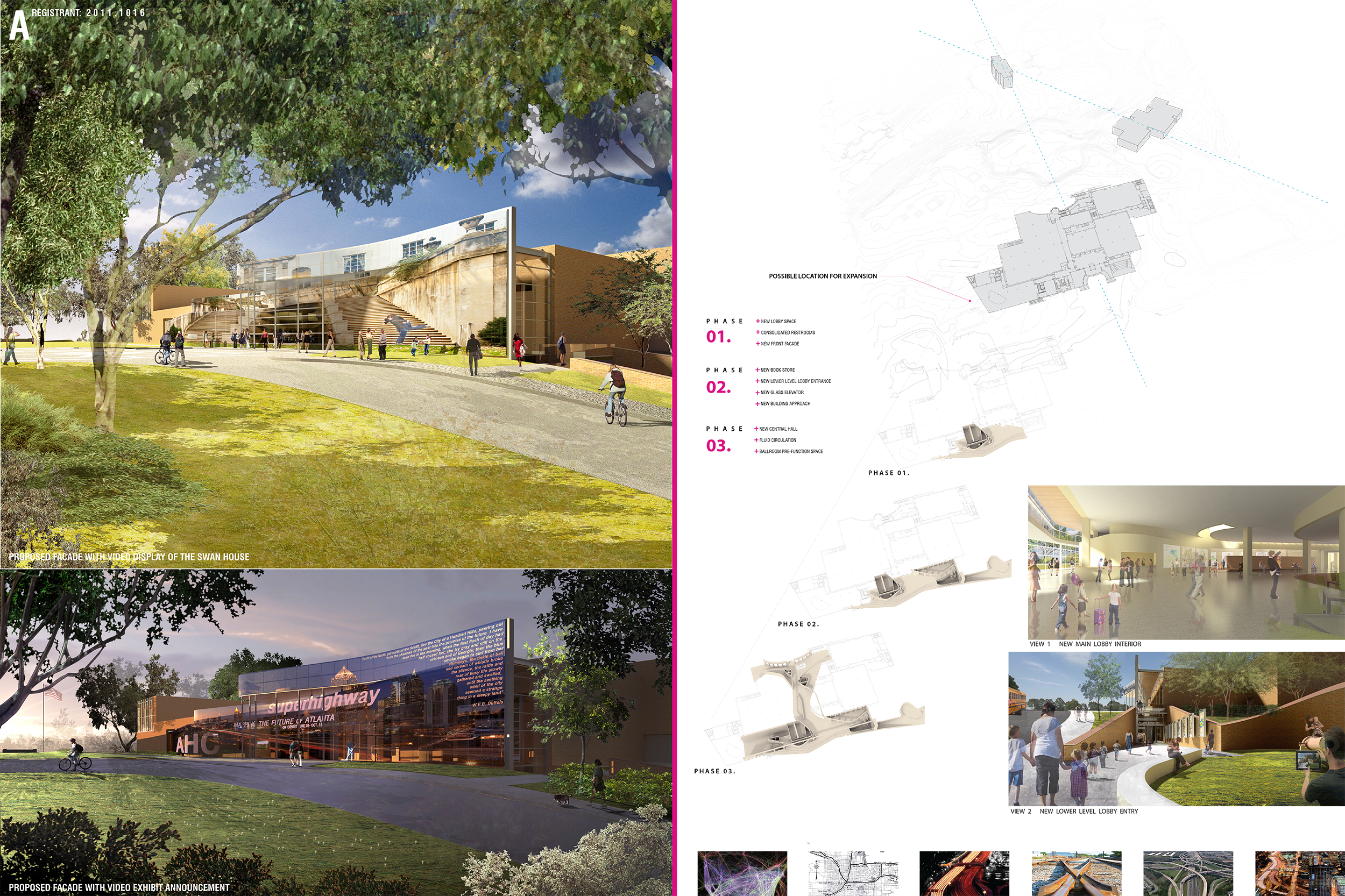
Competition Entry | Board 01
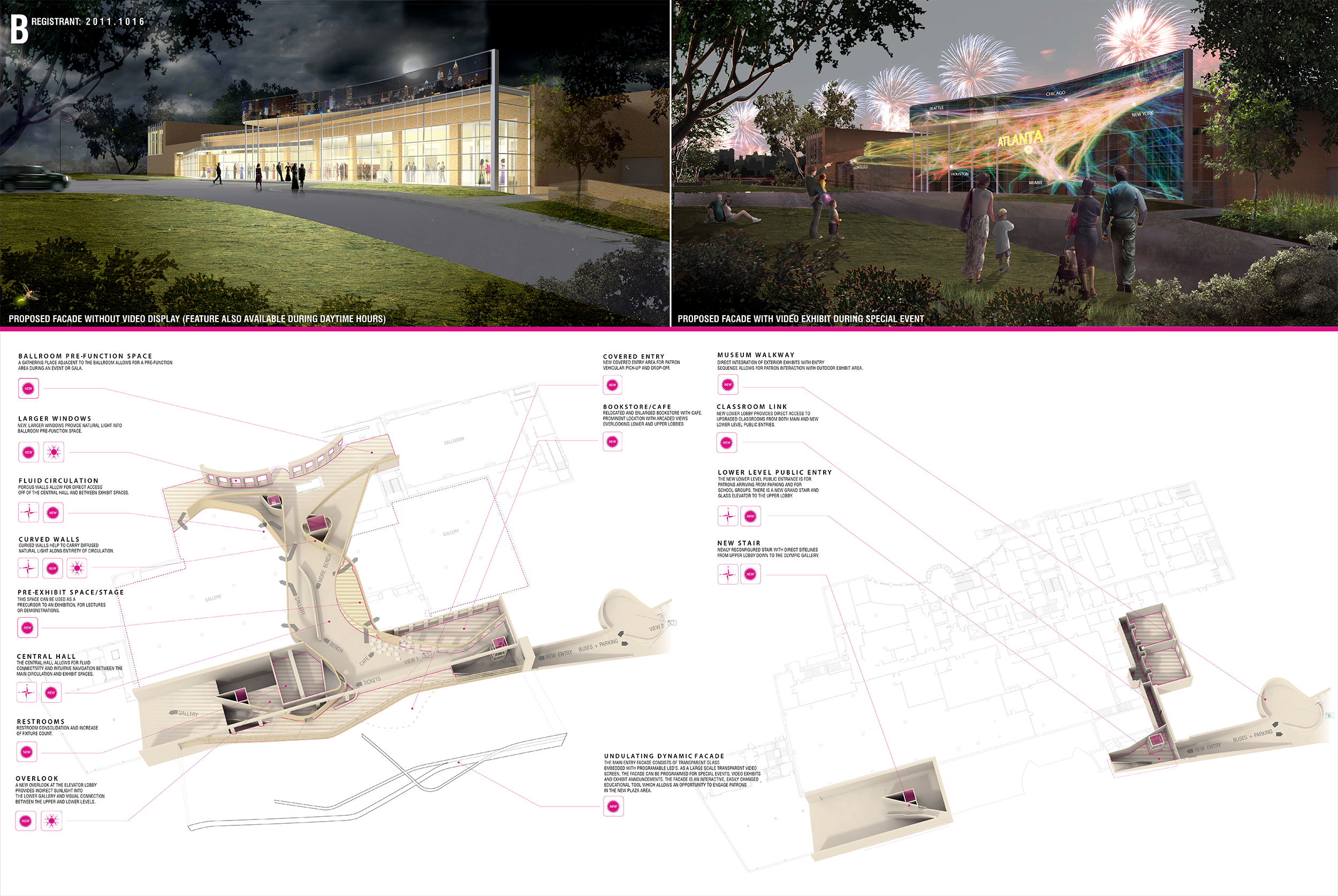
Competition Entry | Board 02

Rendering: New entry facade as would be seen during early morning commute into downtown Buckhead. Predominantly facing North, the glass facade is a changing exhibit in of itself. The programable LED-embedded glass provides for a modern re-interpretation of the mural as narrative.
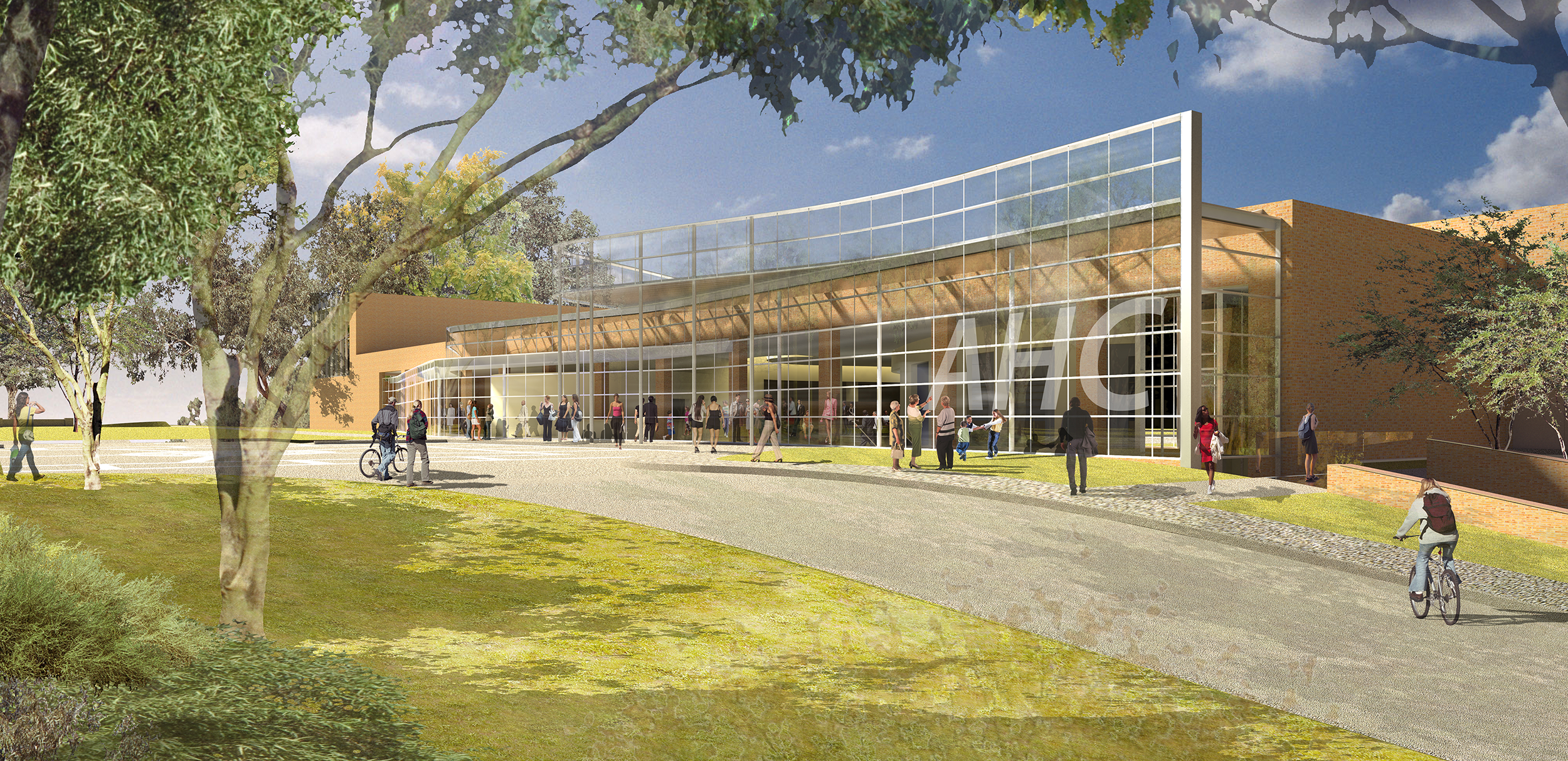
Rendering | Here glass facade is set to 'transparent' except for the illuminated AHC.
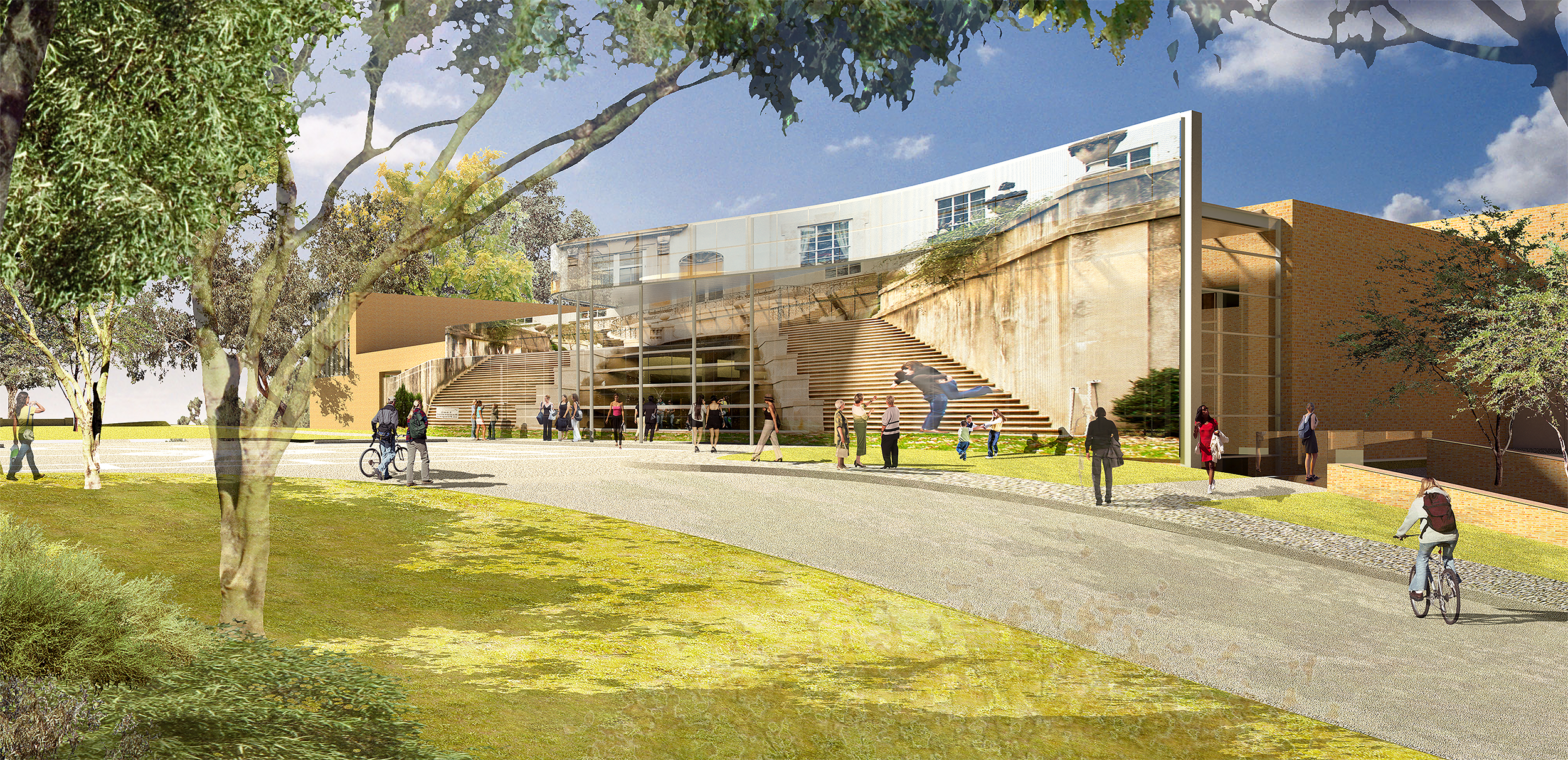
Rendering | Among the Center's several properties around Atlanta's greater metro region, the Swan House, featured as 'today's" facade, is a favorite destination for residents of the area.
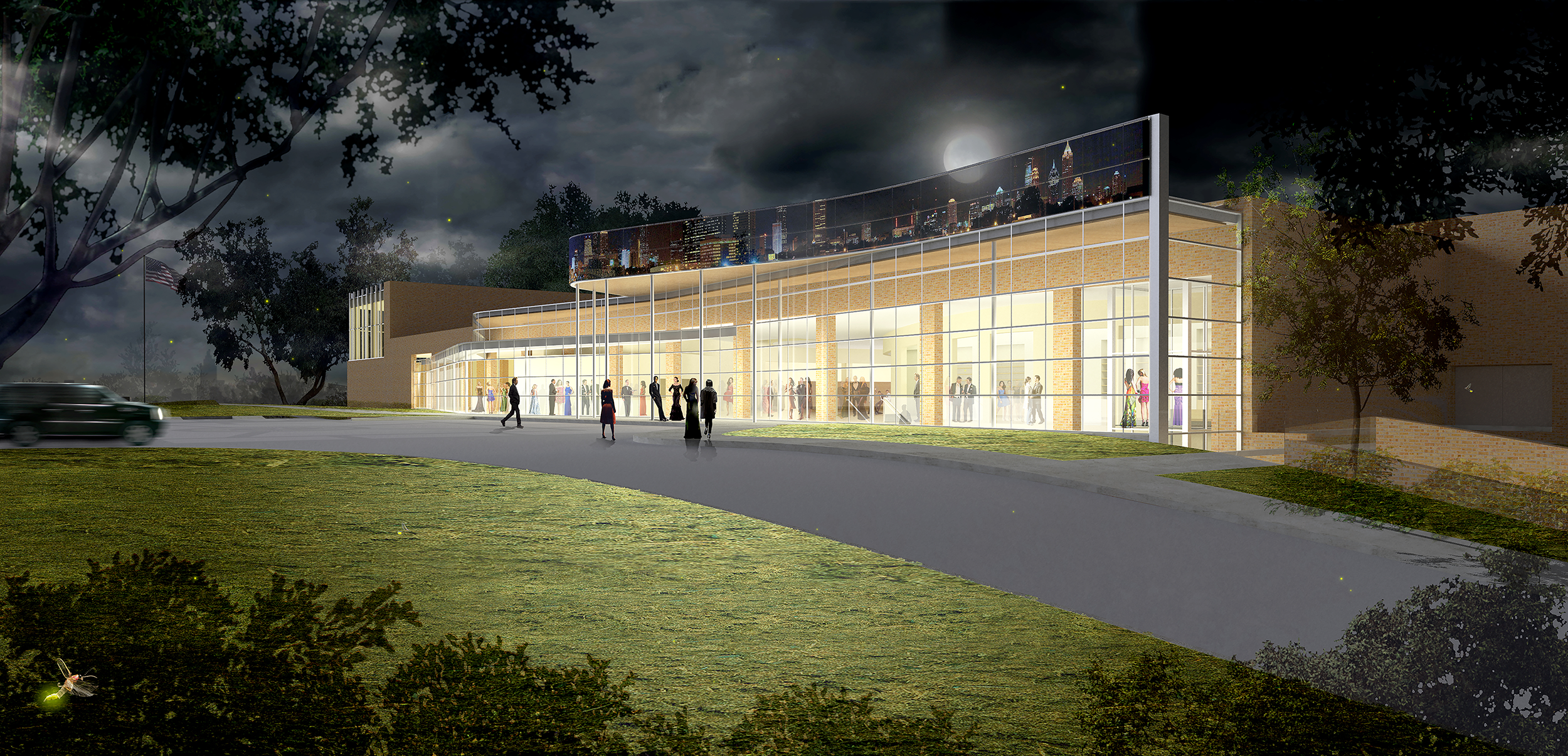
Rendering | A black-tie fund raising event is showcased through the facade's vitrine, as the Buckhead skyline is displayed on the glass facade's upper panels.
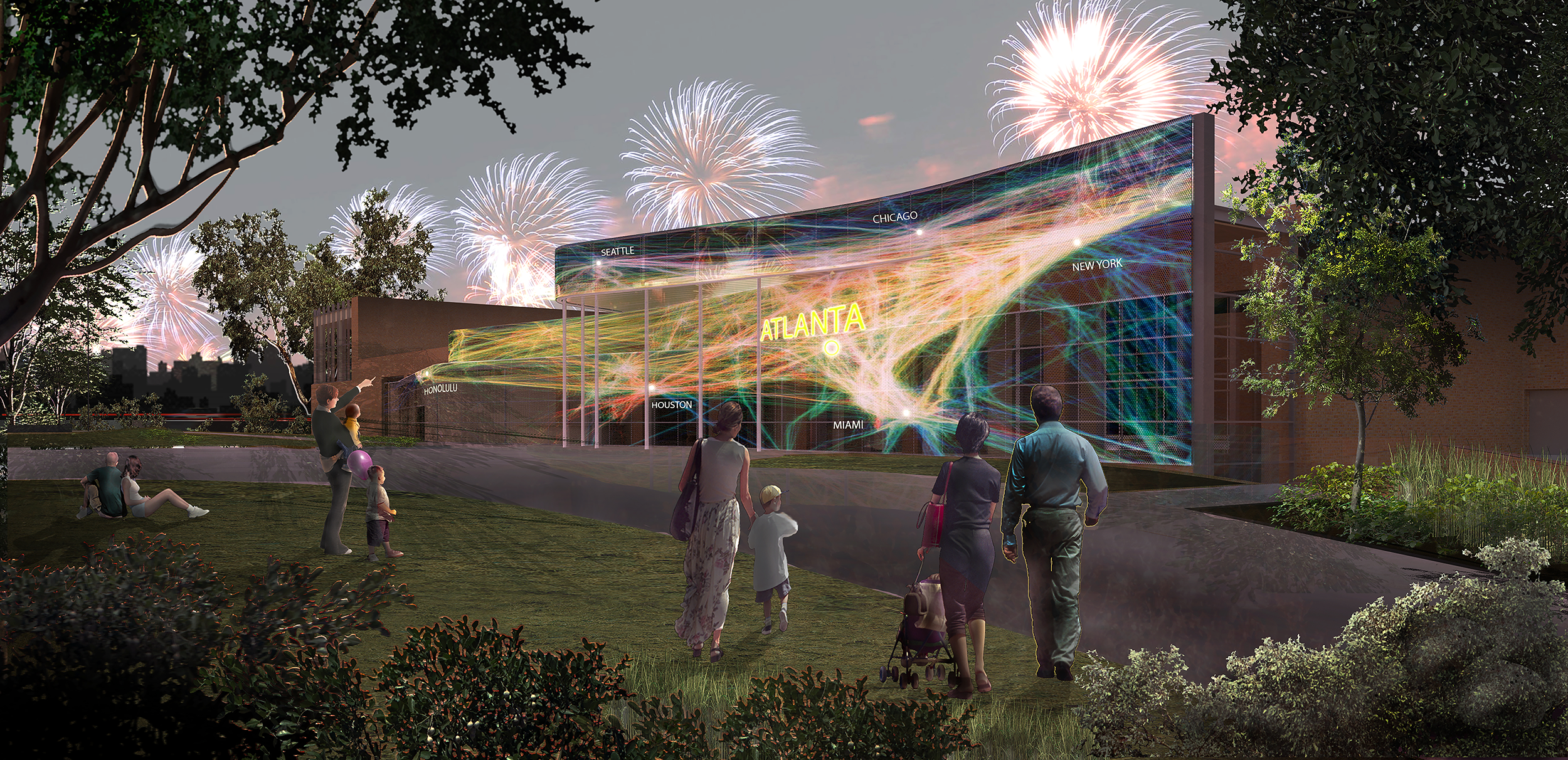
Rendering | New summer events programing on the plaza of the Atlanta History Center could take advantage of the digital 'backdrop.'
Atlanta History Center
Renovation and Addition | Buckhead, GA
The design was inspired by Atlanta’s transportation and communications infrastructure which has not only shaped Atlanta’s future both physically as well as strategically, but had also defined the City’s origin, fed its growth, and gave rise to the modern network that extends far beyond the confines of the metropolitan area.
The design was also inspired by the pragmatic: the Atlanta History Center would need a clear, well defined and graceful interplay between the exhibits and the main public thoroughfare. If at the urban scale of Atlanta the automobile defines the public thoroughfare, where distances between locations are great, at the civic level the thoroughfare is defined by the pedestrian. Rather than simply organizing circulation between a beginning and a terminus, circulation for the pedestrian is more meandering in nature, one that is more intuitive, responding to suggestion and discovery but still clear and linear, or in this case, curvilinear.
The primary charge was to create a recognizable, meaningful and unforgettable entry experience for the patron, whether they are dropped off at the main entrance or arrive from the garage; a successful design would address this dichotomy, giving the Center an urban and monumental entrance along West Paces Ferry Road but also a less formal entrance from the direction most patrons would be arriving: the parking. In such a manner, the addition of a separate and dedicated entrance at the lower level lobby provides a closer, more convenient entrance to the building from the parking area. Upon arrival, the patron experiences the light filled double height atrium connected by a grand stair to the upper lobby level. The lower level entrance also serves as the primary entrance to tour groups.
Owing to the new façade, made entirely of glass and a contemporary reinterpretation of the ‘veranda’, the Center’s new image is now one of both transparency and endless possibilities. Using O-LED technology, the facade can easily convert to a large transparent digital diorama programmable in a multitude of ways: from the display of upcoming exhibits to digital photo essays and summer lecture series on the plaza.
Undulating from West to East like a flag in the wind, the facade sets the stage for the newly reorganized flow of traffic within. The objective was to give access to all the exhibit spaces from one centralized experience while also creating visual connectivity throughout the building. The curvilinear walls transition from one exhibit to the next seamlessly, while always keeping the patron well oriented and in control of their learning experience. Much in the same manner, the undulating geometries accentuated by the natural light diffused along their entire length maintain a constant visual connectivity from pre-function to exhibit.
In the case of the Olympic Gallery, the approach has been simplified and brought back into the fold: the veranda’s façade billows in an apparent gesture to allow traffic to ‘round the bend’ with plenty of natural light and views to the lush landscape leading the way.
This connectivity is paramount to the success of the Center. Fluid movement, site-lines, and natural light drive the form-making. Combined with the forward thinking of digital technology, the building will viewed in a new light. No longer simply a container for information and artifact, the Atlanta History Center will itself be an exhibit, one that not only extends its confines to the public when the doors are open, but also engages the community when its doors are closed.
Design Team:
Lorenzo Mattii, AIA - Principal, Lead Design | While previously employed by Pfeiffer - A Perkins Eastman Company
David Irwin, Designer | Presently owner of The Terra Project LLC
Walt Crimm, Museum Sector Leader | Presently owner of Walt Crimm Associates
Architect of Record: Pfeiffer - A Perkins Eastman Company